Table of Contents
White Label SEO Platform vs. Reporting Tool Basics
Understanding the difference between a comprehensive platform and a basic tool is essential for agencies building SEO services under their own brand. We see a white-label SEO platform as an integrated ecosystem--a white label seo software white label seo platform that combines diverse capabilities like keyword tracking, backlink analysis, content automation, and detailed reporting, all presented under your agency's logo. This goes far beyond data visualization, embedding the automation and management features you need to run complete campaigns, and is the methodology we rely on to deliver SEO Under Your Brand.
In contrast, a basic reporting tool focuses narrowly on dashboard-style visualizations. For example, Airefs provides live link-data dashboards and API access that help illustrate the reporting-tool side of the comparison. Meanwhile, a true white label seo management platforms solution integrates much more: it brings together the monitoring features you would find in standalone white label seo tools with content and link-building automation. For agencies, this breadth makes a significant difference when illustrating key report types, such as those covering the difference between local seo and organic seo, because the data and context are already unified under one login. Merchynt demonstrates this integrated approach in a white label seo software context by pairing backlink data with broader local metrics. A singular white label seo tool simply cannot match the workflow consolidation you achieve with a full platform.
Choosing a full white-label platform means you gain a white label seo dashboard that ties strategy to execution, not just a snapshot of historical data. With platforms like ours, agencies are equipped to handle the full spectrum of client requirements--from granular local ranking projects to expansive national campaigns, all while understanding the strategic differences between local seo vs national seo. This operational consolidation fuels better client retention, effortless scalability, and stronger margins, transforming an seo software white label ecosystem into a true growth engine for your business.
Evaluating White Label SEO Platform Features
Selecting the right white label seo software white label seo platform demands a structured evaluation of capabilities versus agency needs. We examine core features, test them, and gauge operational impact.
The evaluation follows three simple steps.
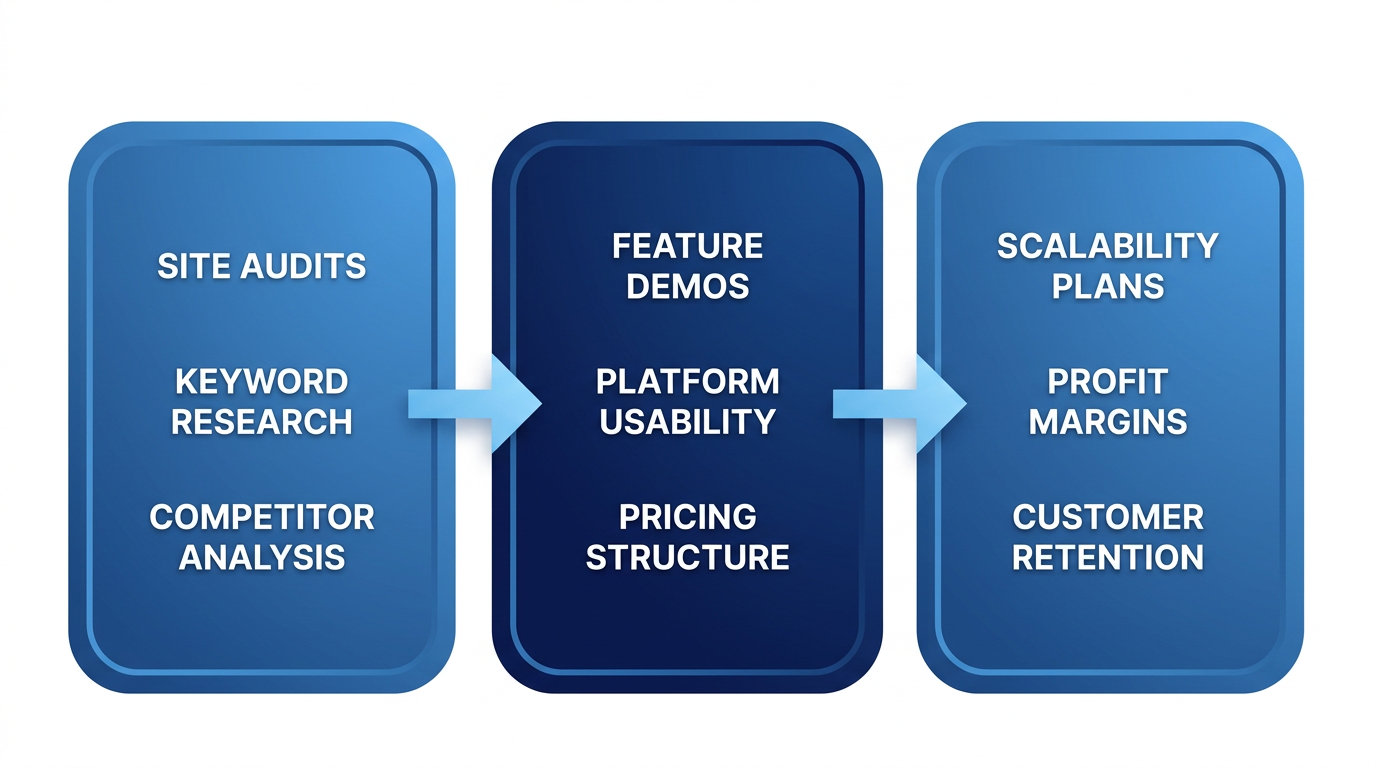
Three-step evaluation process for white-label SEO platform features.
What to Evaluate
Must-have capabilities include automated link building (matching BRON-style networks), geo-targeted content creation (powered by CADE-like engines), rank tracking, local citation management, and white-label client reporting. For local strategy, consider tools that help clients get more reviews for local seo to complement citation efforts. Top-tier white label seo tools consolidate these features, reducing the need for multiple vendors.
How to Evaluate
We recommend requesting a demo, running a trial campaign on a low-stakes keyword, and checking dashboard usability. A clean white label seo dashboard is essential for client-facing reports. Test how the seo software white label pulls data from Google Search Console and Google Analytics--seamless integration signals a mature platform.
What the Answer Means
A fully automated white label seo software white label seo platform reduces manual overhead and vendor fragmentation. When a white label seo tool lacks automation, agencies must patch multiple solutions, increasing complexity. The right platform streamlines operations, letting teams scale efficiently.
Customization and White Labeling Depth
Beyond basic white labeling, the depth of customization determines how seamlessly you can brand every touchpoint in a white label seo software white label seo platform. We evaluate three levels of vendor invisibility so you can give clients a fully branded experience.
What to Evaluate
We look at the entire spectrum: logo replacement on reports, a custom domain for the client dashboard, branded email notifications, and client portal authentication that hides the underlying vendor. A robust white label seo dashboard should show zero third-party logos or links in client-facing views, allowing you to present the platform as your own proprietary toolset.
How to Evaluate
We recommend a hands-on test to verify depth of custom branding:
- Create a test client account inside the platform.
- Inspect every client-facing email and report header for third-party branding.
- Verify the dashboard URL matches your agency's custom domain.
- Confirm the client portal authentication page displays no vendor logos or links.
This checklist ensures your entire white label seo management platforms workflow appears native to your agency.
What the Answer Means
Deep customization means clients see a seamless agency-branded environment, which can help build trust and reduce churn. When agencies use effective white label seo tools, clients are not distracted by third-party branding. Without deep white labeling, you may need to explain away another vendor's logos, potentially eroding the professional image you've worked to establish.
Integration Ecosystem and API Access
Agencies evaluating a white label SEO platform must verify that it connects effortlessly with the tools already in their stack. When integration is tight, the white label SEO software becomes the operational backbone, not another silo.
What to Evaluate
Assess essential integrations including Google Analytics 4, Google Search Console, call tracking platforms like CallRail, and CRM systems such as HubSpot or Salesforce. Review any proprietary API for documentation quality and authentication methods. Strong white label SEO tools connect these systems to create a unified data flow.
How to Evaluate
Set up a test data connection between the platform and a GA4 sandbox, along with a CRM sandbox. Confirm that reports populate automatically without manual imports. Verify that API rate limits comfortably accommodate your agency's typical usage volume, ensuring the SEO software white label solution functions reliably under real workloads.
What the Answer Means
Seamless data flow establishes a single source of truth for client reporting within the white label SEO dashboard. In contrast, poor connectivity forces manual data reconciliation across systems, eroding the efficiency that white label SEO management platforms are meant to deliver. Tight integration preserves the white-label promise of a polished, unified reporting experience.
Security and Data Sovereignty
Beyond features and cost, the security posture of a white label seo software white label seo platform is critical to protecting your agency and your clients. We recommend agencies treat security readiness as a prerequisite for client trust, not an afterthought, especially when vetting any white label seo management platforms.
What to Evaluate
Begin by looking for SOC 2 Type II certification, AES-256 encryption for data at rest and in transit, and published GDPR and CCPA compliance documentation. Examine the vendor's privacy policy for explicit data residency options and a complete subprocessor list. In a white label seo software environment, these credentials demonstrate that the provider follows recognized operational and privacy controls.
How to Evaluate
Request the vendor's security whitepaper, review the data processing agreement for clear subprocessor and liability clauses, and check for independent third-party audit reports. If the platform handles high-value client data, arrange a penetration test within your white label seo tools evaluation period to validate real-world defenses. Reputable providers welcome external scrutiny of their data protection posture.
What the Answer Means
Strong security assurance reduces your agency's liability and builds client confidence during contract reviews. Conversely, weak controls risk data breaches and loss of contracts in regulated verticals like healthcare or legal. With these evaluation criteria in hand, you are ready to assess the operational and support side of your chosen platform.
Red Flags in White Label SEO Platforms
However, not all platforms are created equal. When evaluating a white label SEO software white label SEO platform, we recommend watching for these warning signs. Providers promising guaranteed rankings or traffic increases violate SEO best practices and should be approached with caution. Vague reporting is another major red flag -- an effective white label SEO dashboard must offer transparent, granular data--not just summary-level metrics--so you can verify link quality and progress. Separately, a provider who hides backlink sources when using white label SEO tools prevents you from auditing the campaign's true value. Beware of inflexible contracts that lock you in without performance milestones or exit clauses, especially when testing a new white label SEO tool. Support responsiveness is equally critical. If you cannot reach a dedicated account manager quickly during a campaign crisis, it signals deeper operational issues in their white label SEO management platforms. Finally, be sure your SEO software white label partner is clear about all costs upfront; hidden fees for essential features like reporting erode your margins and trust. By avoiding these pitfalls, you can confidently select a partner that meets your needs.
Questions to Ask Before Choosing a White Label SEO Platform
To help you make an informed choice, here are the key questions to ask before selecting a white label seo software white label seo platform. When you evaluate any seo software white label, we recommend vetting it against the criteria below--each tied to the services your agency will actually rely on.
- Automation depth: Does the platform handle backlink building and content generation at scale, or is it limited to basic rank tracking and on-page audits?
- Dashboard branding: Can you fully customize reports in the white label seo dashboard with your own logo and remove any provider references?
- Integration fit: Does it connect natively with WordPress, Shopify, and the analytics tools your team already uses?
- Support & training: Is there a dedicated account manager, a searchable knowledge base, and live onboarding webinars--not just a ticket queue?
- Scalability: Can the platform manage 10 clients today and 100 next quarter without slowing down or degrading report quality?
- Pricing clarity: Is the model transparent, with clear definitions of what counts as an extra keyword, site, or reporting seat?
- Data ownership: Who owns the content and link assets you produce, and can you export everything if you change white label seo tools?
- Results timeline: When evaluating white label seo management platforms, ask what a realistic first-results window looks like across different verticals and site sizes.
- Local SEO readiness: Are listings, citations, and geo-targeted content included in the core package?
A thorough vendor review on these points protects your margins and keeps your clients' campaigns consistent.
Cost Expectations for White Label SEO Platforms
For agencies evaluating white label SEO software white label SEO platform solutions, the investment structure is designed around value rather than rigid pricing tiers. When you adopt white label SEO software, the expense typically reflects the depth of features, the scale of your client roster, and whether you intend to resell these services under your own brand. Costs also shift when comparing local versus organic campaigns; see the difference between local seo and organic seo to understand how scope and resource needs diverge. Pricing models for white label SEO tools align directly with usage volume, making a white label SEO tool far more cost-effective than hiring a full-service team. According to Airefs, industry-standard SEO software white label pricing scales with monitoring frequency and domain support, giving agencies predictable operational costs. Within a white label SEO dashboard, you manage campaigns seamlessly while passing transparent value to clients. Leading white label SEO management platforms position themselves as high-margin enablers, reinforcing that agencies can achieve significant savings over traditional agency retainers when they build on a reseller-friendly foundation.
Local Considerations for Multi-Location Agencies
While agencies enjoy the core benefits of white-label SEO, serving clients with multiple locations introduces unique complexities. Each location may have distinct competitors, localized search behavior, and unique Google Business Profile data that must be optimized independently. Agencies need to understand local SEO vs national SEO to balance targeted geographic tactics against broader brand campaigns, ensuring every client location maintains relevance in its specific market.
The operational challenges multiply quickly. A centrally managed white label seo dashboard must still provide location-level granularity for keyword tracking and citation audits. Reporting needs to be customizable per location yet consolidated into a single, branded view for the client. Agencies also face the complexity of scaling content personalization city-specific landing pages without fragmenting brand coherence. According to Merchynt, effective multi-location management requires tools that handle listing distribution and local citation management across hundreds of locations while maintaining speed and consistency.
A robust white label seo software white label seo platform solves these pain points by unifying campaign oversight. With the right seo software white label foundation, agencies can maintain their own brand across all client-facing communications while delivering location-specific results at scale. This approach becomes the strategic answer for agencies that need to grow efficiently without compromising quality or control.
White Label SEO Platform Evaluation Checklist
When choosing a white label seo platform, we recommend agencies evaluate these key capabilities:
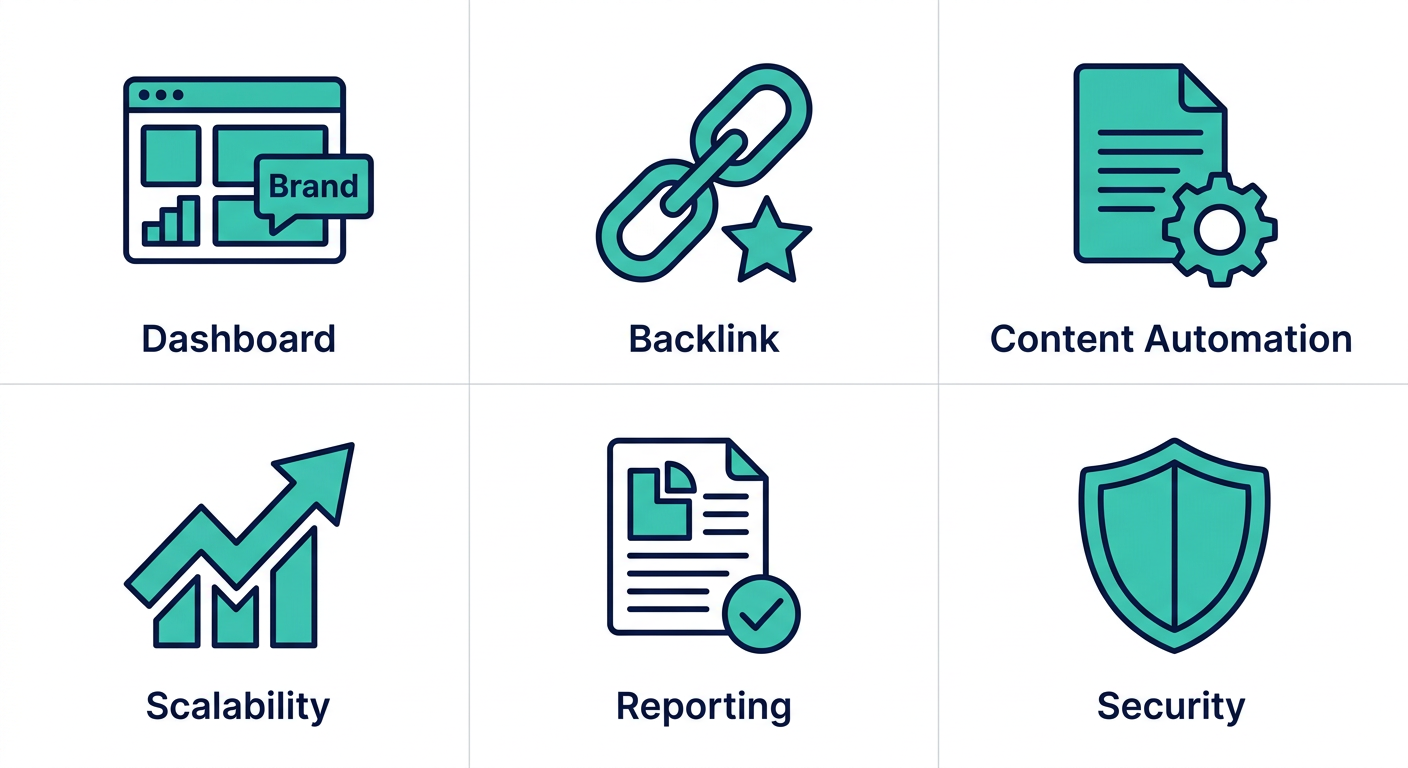
Icon-set for White Label SEO Platform Checklist
- Confirm the platform offers a fully branded white label seo dashboard that removes all provider logos so the agency can present it as its own proprietary interface.
- Verify the backlink acquisition relies on niche-relevant, automated systems like BRON rather than generic directories--an essential consideration within modern white label seo tools.
- Assess content automation: the platform should include AI-driven generation and scalable drips like CADE to support unlimited client programs.
- Demand transparent, client-ready reports covering keyword rankings, traffic, and backlink metrics.
- Ensure the platform scales without per-client fees or performance degradation.
With these criteria in mind, our white label seo software sets a clear standard for agency-driven growth.
Frequently Asked Questions About White Label SEO Platforms
What is a white label seo platform and how does it work? A white label seo platform empowers your agency to offer SEO services under your own brand while we handle the fulfillment using
How fast can I expect results with white label SEO? While full campaigns mature over time, the platform targets measurable progress within 30 days so your clients see early momentum, not just promises.
Can my agency resell BRON and CADE under our own brand? Yes. Every module is designed for resellers, and you can manage client accounts completely under your branding in the white label seo dashboard.
How does white label SEO compare to hiring an in-house team? The operational model is built to be significantly more cost-effective than maintaining full-time staff, which is how agencies run SEO campaigns at roughly 80% cheaper than an in-house department.
What kind of tools and support do resellers receive? Your team gets a full set of white label seo tools--including backlink placement, content automation, and integrated reporting--backed by dedicated support. For agencies new to local SEO, our local seo glossary for beginners provides a quick reference.
Choosing the Right White Label SEO Platform for Agency Growth
When evaluating white label SEO software white label SEO platform options, start by consulting a local seo glossary for beginners to clarify key terminology. We recommend prioritizing three criteria:
- Automation depth -- Look for BRON-driven backlink building and CADE-powered content creation that scale without adding headcount.
- Reseller economics -- A transparent, reseller-friendly structure built 80% Cheaper Than Agencies keeps margins healthy.
- Brand continuity -- With a white label seo dashboard, you deliver reports and insights directly under your logo.
Built for agencies. Ready to scale. These management platforms also let you validate 30 Days to First Results momentum before scaling campaigns. Before committing, review the seo local terms of service for specific usage parameters, then sign in to the seo local sign in portal to experience the criteria firsthand.